
Finding Grady County Warrants
There is no single official Grady County Sheriff page that lists active warrants. The Sheriff's online tools cover inmate lookup and the offender watch list, not a public warrant roster. So the real path is a chain of sources, and you work it until the warrant turns up.
Start with the court case that the warrant came from. Most warrants in Grady County are tied to a felony, misdemeanor, traffic, or city case, and the case file shows the warrant as a docket entry. From there you can check current custody on the jail roster, then call the office that holds the record. Each step adds detail the last one may lack.
The chain runs through five points: the District Court dockets, the county jail roster, the Sheriff and Court Clerk phone lines, the Chickasha Municipal Court for city cases, and the statewide offender system for state custody. Work them in order and you cover nearly every kind of Grady County warrant.
Note: No official county warrant database exists, so treat any single search result as a lead and confirm it with the Court Clerk or the issuing court before you act.
Types of Warrants in Grady County
Warrants come in a few forms, and the type tells you which court or agency to call. A warrant from a city case lives in a different office than one from a felony case. The list below covers the kinds you are most likely to meet in Grady County.
- Arrest warrant - issued to take a person into custody on an alleged criminal offense.
- Bench warrant - signed by a judge after a failure to appear, a failure to pay or comply, contempt, or a probation issue.
- Search warrant - authorizes a search and may stay sealed before or after it is carried out while a case is active.
- Fugitive warrant or hold - an out-of-county or out-of-state warrant that can show up in local custody records.
- Municipal warrant - a city court warrant for not appearing on or not complying with a citation.
Grady County Bench Warrants in Court Dockets
Bench warrants and failure-to-appear events are logged on the case docket, so the court record is the most reliable warrant source for the county. Two free systems carry Grady County District Court cases. You can search On Demand Court Records at ODCR, and you can search the statewide docket index at OSCN. Both let you pull a case and read every action the judge took.
Open the docket and scan the event lines. Warrant activity shows up in plain language, and the same phrases repeat across cases. When the entry says the warrant was returned and the person was arrested, that warrant has already been served.
- Issue Bench Warrant
- Return of Bench Warrant - Arrested
- Failure to Appear
- Bond Forfeiture
Read the dates and the bond language together. A bench warrant with an open bond means the court still expects action, while a return entry means the matter moved into custody or back onto a hearing calendar.
How to Search Grady County Warrants
Because the search runs through case records, you use the court portal search fields rather than a warrant-only form. Name and case number are the two strongest inputs. The table lists the fields the docket search accepts, which is the same form you use to find a bench warrant entry.
| Field Label | Type | Required | Notes |
|---|---|---|---|
| Party Last Name | Text | Yes | Main input; use the legal last name on the case. |
| Party First Name | Text | No | Narrows results when a last name is common. |
| Case Number | Text | No | Fastest path; uses a prefix such as CF, CM, or TR. |
| Court or County | Dropdown | No | Select Grady to limit results to the county. |
| Case Type | Dropdown | No | Filter by criminal, traffic, or other category. |
| Date Range | Date | No | Limits results to a filing window. |
The docket portal is a convenience copy of the court record. If an online entry and the clerk's file ever disagree, the official case-management record controls, so confirm anything that matters with the Court Clerk.
What a Grady County Warrant Record Shows
A warrant record, whether you read it on a docket or in a custody charge line, carries a set core of details. These fields tell you the offense, the money at stake, and where the case stands. The table maps each field to what it shows.
| Field | What It Shows |
|---|---|
| Warrant or Case Number | The unique number tying the warrant to its court case. |
| Description or Offense | The alleged offense or reason, such as Failure to Appear. |
| Court or Case Prefix | The code for the case type, such as CF, CM, or TR. |
| Charge Type | The classification, which may read as unclassified. |
| Bond Amount | The dollar amount set for release, which can be zero. |
| Fine or Amount Owed | Any fine, cost, or balance tied to the case. |
| Issuing Court or Judge | The court or judge listed on the docket, when shown. |
| Return or Arrest Date | The date the warrant was served, if it was executed. |
| Related Disposition or Next Hearing | The case outcome or the next court setting. |
Note: Many fields can read as blank or zero, so a missing value does not mean a warrant is closed; always check the latest docket entry for status.
Warrant Fields on the Grady County Jail Roster
When a person is already in custody, the jail roster can confirm the warrant tied to that booking. The public roster for the Grady County Detention Center runs through a vendor system, and you can open it at the Grady County jail roster. Each profile carries a charge table that names the warrant or case number.
The charge line is short but useful. A sample profile listed warrant or case number CM-26-201 with a description of Failure to Appear, a charge type of Unclassified, a bond amount of $0.00, and a fine amount of $0.00. That single line links a booking to the exact court case behind it.
The roster is a custody snapshot, not the full court file. For the charges the prosecutor actually filed, follow the case into the Grady County criminal court records, and use the jail roster guide for booking detail and contact steps.
Chickasha Municipal Court Warrants
Not every Grady County warrant comes from the District Court. City citations are handled by the Chickasha Municipal Court, and that court issues its own warrants. The city's own page states that a failure to obey a notice to appear, or a failure to comply with a citation in any manner, causes the municipal judge to issue an arrest warrant.
Municipal warrants do not show on the District Court dockets, so a city case needs its own call. The municipal court can confirm a warrant, a court date, a bond, and any plea or payment option. A Chickasha conviction may be appealed to the District Court of Grady County by filing an intent to appeal within ten days of the guilty finding.
Grady County Warrant Phone Channels
Phone lines often answer faster than any search, and a clerk can read the current status of a warrant straight from the file. Three offices cover most warrant questions in the county. The table shows which line to call and what each one handles best.
| Office | Phone | Best For |
|---|---|---|
| Grady County Court Clerk | 405-224-7446 | Bench-warrant and failure-to-appear docket entries, court dates, certified records. |
| Grady County Detention Center | 405-222-1000 | Current custody and warrant-related custody questions. |
| Grady County Sheriff's Office | 405-222-5085 | General law-enforcement questions; dial 911 for emergencies. |
The Court Clerk, Mica Hackney, keeps the case files that record bench warrants and failures to appear, and the office can be reached through the Grady County Court Clerk page. For custody-side questions, the Grady County Sheriff's Office and the detention center share the contact lines above.
Note: Office hours run Monday through Friday, so a warrant question raised on a weekend may not get a full answer until the next business day.
Statewide Fugitive and Offender Lookup
Some warrants connect to state custody rather than a county case, and a statewide tool covers that ground. The Oklahoma Department of Corrections runs an offender system with a fugitives section, which you can open at the Oklahoma DOC offender lookup. It is a state correctional resource, not a county warrant search.
The DOC search page makes its scope clear before you start, as the screenshot below shows.
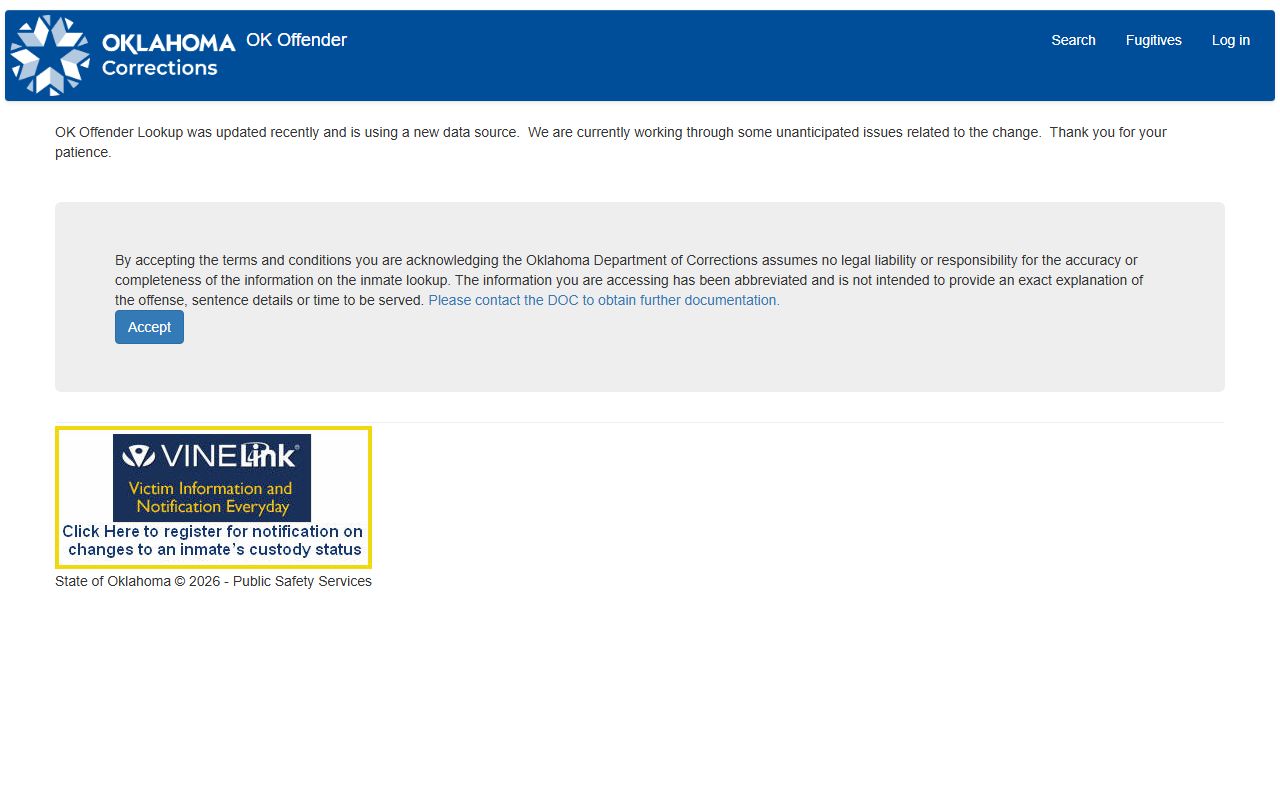
The agency warns that its information is abbreviated and is not an exact account of an offense, a sentence, or time left to serve. Use it to place a person in the state system, then confirm any Grady County warrant detail with the court or the Sheriff.
Resolving a Grady County Warrant
An open warrant does not clear on its own, and a stale web result is not proof that it is gone. The safest course is to confirm the warrant, learn the bond, and plan the next step with help. The steps below move from finding the case to confirming the warrant was recalled.
- Identify where the case began: Grady County District Court, Chickasha Municipal Court, another city court, or a state or federal agency.
- Search ODCR or OSCN for the case and read the docket for a bench warrant, a failure to appear, a bond forfeiture, or a return of warrant.
- If the person is in custody, check the Grady County roster for the warrant or case number, the charge description, and the bond amount.
- Call the Court Clerk or the Municipal Court before appearing and ask about the court date, bond, payment plan, recall or quash steps, and whether counsel is needed.
- If surrender is required, coordinate with an attorney, a bondsman if allowed, and the law-enforcement facility rather than acting on an old web result.
- After payment, a plea, or a court appearance, confirm the warrant was recalled and that the docket now reflects the resolution.
Important: Speak with a lawyer before you turn yourself in, since counsel can arrange a bond, a recall, or a hearing date and protect your rights at the surrender.
Restricted Grady County Warrant Records
Not every warrant is open to the public. Search warrants can stay sealed while a case is active, juvenile matters are confidential by law, and active-investigation material is protected. So a warrant can exist without showing in any record you can reach. Law-enforcement records follow their own disclosure rules under state statute.
The rule that governs this access is set out in the Oklahoma Statutes, and you can read the full text of 51 O.S. 24A.8 on law-enforcement records.
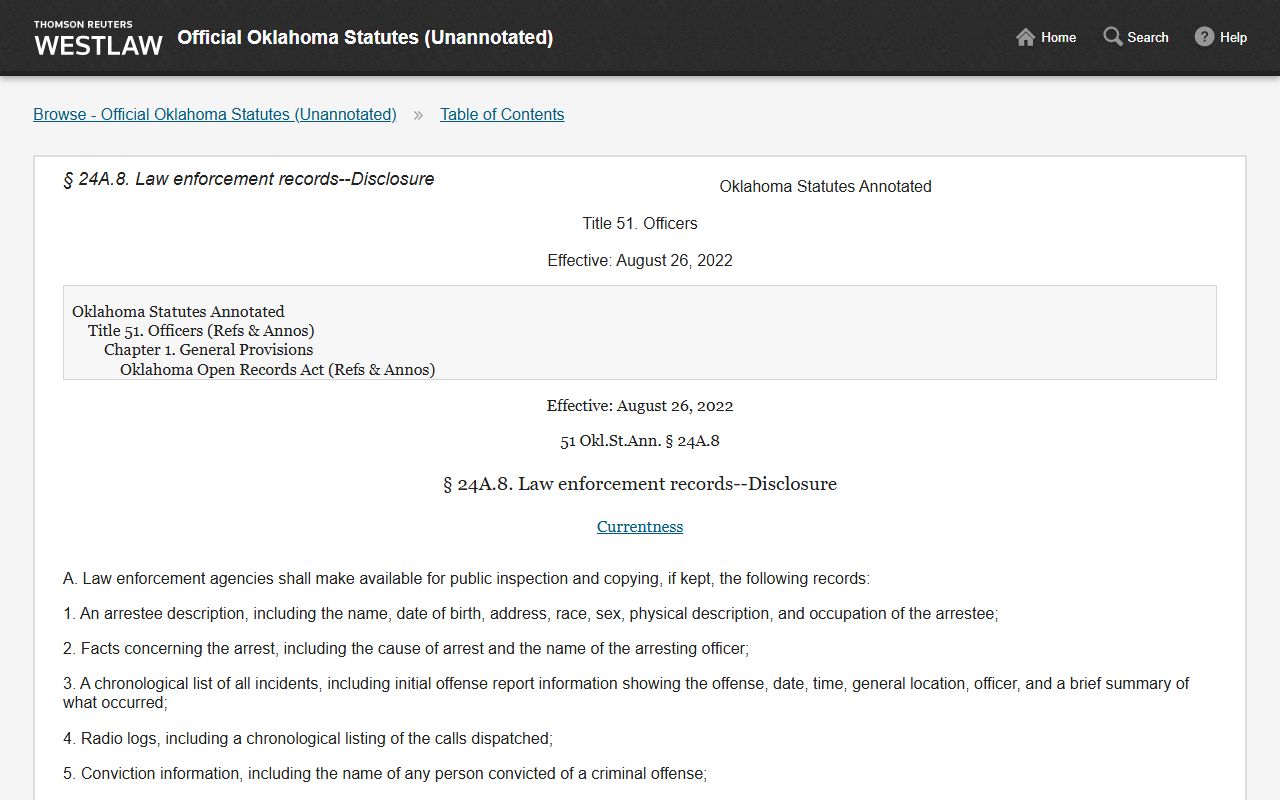
The statute makes some arrest and incident information available while shielding restricted content. Records that are not online can be sought from the office that holds them through an open-records request, subject to the sealed-warrant, juvenile, and active-case limits the law sets.
Crime Stoppers and Anonymous Tips
If you have information about a wanted person, you can pass it on without giving your name. The Chickasha Police Department runs a CrimeStoppers tip line at 405-224-TIPS for anonymous reports. Tips can help locate people with active warrants while keeping the caller out of the case.
Note: A CrimeStoppers tip is for sharing information, not for resolving your own warrant; use the Court Clerk or an attorney for that.