
What Grady County Probate Covers
Probate is the legal process that settles a person's estate after death. It deals with the will, the debts, and who receives what. In Oklahoma, probate is not run by a stand-alone court. It is handled as a division of the District Court. The Grady County District Court hears these cases, and the Court Clerk keeps the files. The same office also files guardianship, conservatorship, and the filing of wills.
The Court Clerk in Chickasha is the records custodian for the entire estate caseload. A probate case often starts when someone dies and an estate must be opened. Other matters protect a living person who cannot manage money or health choices. The local filings group into a few main types.
- Estates with a will, known as testate, and estates with no will, known as intestate
- Guardianships of minors and of adults who cannot care for themselves
- Conservatorship of a person's estate or property
- Trust proceedings tied to an estate
- Filing of a will for the court record
All of these move through the District Court. A judge signs the orders that open and later close the case.
Probate Terms Defined
Probate files use words that rarely come up in daily life. A short guide helps when you read a docket or a court order. These five terms appear in most Grady County estate and guardianship cases.
- Testator
- The person who made the will. After death, the will speaks for how that person wished to pass on property.
- Executor
- The person named in the will to carry out its terms, gather assets, pay debts, and distribute what remains.
- Intestate
- Dying with no valid will. State law then sets the order of who inherits the estate.
- Guardianship
- A court order giving one person the duty to care for a minor or an adult who cannot care for themselves.
- Conservatorship
- A court order placing a person's money or property under the care of a named manager.
How to Search Grady County Probate Records
Most Grady County probate records can be found online at no cost. Two state systems carry them. On Demand Court Records lets you search by party name, case type, or case number for participating Oklahoma courts, and Grady is one of them. The Oklahoma State Courts Network handles case-number lookups and daily filing reports for the Grady County District Court. For an older file or a certified copy, the Court Clerk is the source.
- Open ODCR and choose the Grady County District Court from the court list.
- Enter the decedent, ward, or petitioner name, last name first, or type a known case number.
- Narrow the search by a probate case type, such as Probate Proceedings, Guardianships, or Filing of Wills.
- Use OSCN to pull a case by number or to read the daily docket for the District Court.
- For the full file or a certified copy, call or visit the Court Clerk in person.
When a record is not online, a public-records request can be routed to the right office. The Grady County open-records page explains that requests may be made in person, by mail, or by email when a department accepts it. Older or non-digitized probate files go to the Court Clerk, while recorded estate papers go to the County Clerk.
Note: ODCR shows index and docket facts, but the official certified probate file must come from the Grady County Court Clerk in Chickasha.
Wills, Estates, and Guardianships
The probate division covers more than a single case type. ODCR groups Grady filings into many labels, and the spread shows how broad estate work can be. Common categories include Probate Proceedings, Probate Miscellaneous Proceedings, Trust Proceedings, Conservatorship, and Guardianships.
Estate cases also generate their own milestone filings. A search may turn up Filing of Wills, Letters of Administration, Letters Testamentary, the Last Will and Testament, a Final Account and Petition, and the Final Decree that closes an estate. Letters of administration are issued when there is no will, and letters testamentary are issued when an executor is named in one. Guardianship and conservatorship cases protect a living person rather than settle a death, so they follow a separate track inside the same District Court.
Reading the docket in order tells the story of the case. The opening petition, the notice to heirs, the inventory, and the final decree each leave a dated entry.
Small Estate Affidavit Context
Not every estate needs a full probate case. Oklahoma allows an affidavit instead of probate for certain personal property when the total estate value is no more than fifty thousand dollars. This is a shortcut for eligible property, not a substitute for a full probate file. A small-estate affidavit can move a limited asset without opening a court case.
Vehicles follow their own rule. Service Oklahoma publishes a Small Estate Affidavit form used to transfer a vehicle subject to disposition by will when the estate stays at or under that same fifty thousand dollar limit. The motor-vehicle affidavit runs through Service Oklahoma, not the Grady County Court Clerk.
Note: A small-estate affidavit is a probate shortcut for qualifying property only, so a larger estate or a contested one still needs a full District Court case.
Recorded Grady County Estate Instruments
Some estate papers are not court case files at all. When an estate touches land or a vehicle title, the resulting deed or affidavit is recorded with the County Clerk. These recorded instruments are public and are searched through OK County Records, the official county-linked land-records vendor. They sit apart from the probate case file kept by the Court Clerk.
The recorded categories that arise from estates are worth knowing before a search.
- Probate Will and Affidavit of Heirship documents
- Small Estate Affidavit and Proof of Death and Heirship filings
- Executor's Deed and Guardian's Deed transfers
- Conservator's Deed and Trust documents
For the related vital records that often accompany an estate, the same Court Clerk also handles marriage filings covered on the Grady County marriage and divorce records page. The split is simple. The Court Clerk holds the case file, and the County Clerk records the title papers.
Where Grady County Probate Is Filed
Every Grady County probate case is filed at the courthouse in downtown Chickasha. The Court Clerk staffs the office that opens estates, accepts guardianship petitions, and issues certified copies. Use the contact details below to reach the probate venue directly.
Grady County Court Clerk
Grady County District Court
326 West Choctaw
Chickasha, OK 73018
Mailing: P.O. Box 605, Chickasha, OK 73023
405-224-7446
Fax: 405-224-0514
The building itself carries real history. The Grady County Courthouse was completed in 1935 and designed by the firm of Layton, Hicks and Forsyth. It rose as a New Deal era public works project during the Great Depression and now carries National Register reference 05000131. The Oklahoma Historical Society entry for Grady County traces how the county was formed and what records survive from that era.
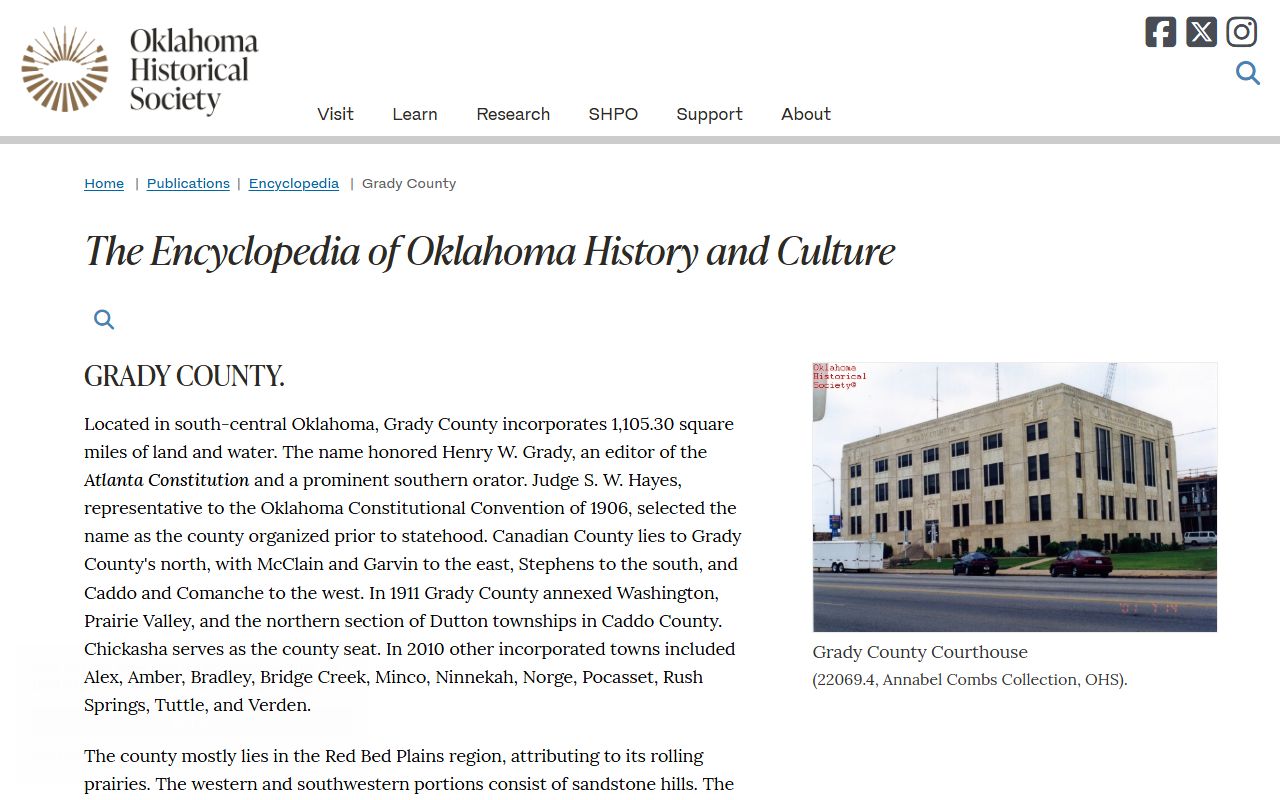
That history matters because the same courthouse still holds the probate files residents need today. Grady County was created at 1907 statehood from lands that had been in the Chickasaw Nation, with Chickasha as the county seat. The Historic Chickasha page from the City of Chickasha names the courthouse among the local National Register places.
The courthouse is not just an address. It is a working civic building where estates have been opened and closed for generations of Grady County families.
Grady County Probate Filing Fees
No Grady-specific probate filing fee schedule was posted by the county at the time of writing. Always confirm the current filing fee with the Court Clerk before you file. The open-records copy fees below are set by state law and apply when you ask for paper copies of a public record. Certified copy pricing comes from the Court Clerk records request form.
| Item | Amount |
|---|---|
| Plain copy per page, open records | $0.25 |
| Certified copy per page | $1.00 |
| Probate filing fees | Confirm with Court Clerk |
| Guardianship filing fees | Confirm with Court Clerk |
The plain-copy rate follows 51 O.S. 24A.5 of the Oklahoma Open Records Act, which directs public bodies to post a fee schedule. Some records fall under other statutes with their own fees. The Court Clerk can quote the exact charge for the file you need.
Note: Do not assume another county's probate filing fees apply in Grady County, since the local schedule was not published and must be verified with the Court Clerk.
Restricted Grady County Probate Records
Not all probate matters are open to anyone who asks. Guardianship records held by an Oklahoma District Court are confidential as a rule. In most cases only the attorneys of record, the guardian, or the ward may review the file without a court order. The Grady County Court Clerk makes the local call on access, so questions about a sealed or confidential file should go straight to that office.
Other limits apply across the estate caseload. Personal identifiers such as Social Security numbers and financial account data may be redacted even when the case stays public. Files that involve a minor or a person under guardianship draw extra care. A judge can also seal a record in a contested estate. When a search returns less than expected, the cause is often one of these protections rather than a missing entry.
For the broader picture of how the District Court keeps and shares its files, the Grady County court records overview explains the access rules that frame every case type, probate included.