
Criminal Court Records in Grady County
A criminal court record is the case file the court clerk opens the moment a charge is filed. It is not the same as an arrest log. The file grows as the case moves, and it holds the charges, the plea, every hearing, each motion, the verdict or plea deal, and the sentence. In Grady County, this file lives with the Court Clerk, who is the records keeper for all District Court cases. The clerk indexes the file, stamps each filing, and keeps the official copy. For a closer look at the charges themselves and how they get filed, the Grady County court charge records page breaks that down.
Grady County criminal cases are heard in the District Court in Chickasha. The court splits criminal matters into two main classes. Felony cases carry the prefix CF, and these are the more serious charges that can bring prison time. Misdemeanor cases carry the prefix CM, and these are lower-level charges. The State of Oklahoma is the plaintiff in every criminal case, and the Grady County Court Clerk files both felony and misdemeanor cases. City citations and local code matters go through the Chickasha Municipal Court instead, which is a separate court with its own files.
How to Search Grady County Criminal Court Records
Two free state systems hold most Grady County criminal case data. The first is On Demand Court Records (ODCR), the county-linked search portal that covers Grady County and many other Oklahoma courts. ODCR is the richest public view of local case files, and Grady records on ODCR begin in 1997 and update hourly. The second is the Oklahoma State Courts Network (OSCN) docket search, which lets you pull a case by number and view daily dockets for the Grady County District Court.
- Open ODCR and pick Oklahoma District Courts, then choose Grady from the court list.
- Search by party name in Last, First form, or enter the full case number.
- Narrow the search by case type, such as Criminal Felony or Criminal Misdemeanor, and by a filed-date range.
- Open the case to read the docket, the offense or cause, the plea, and the disposition.
- Ask the Court Clerk for a certified copy when you need an official record for court or legal use.
OSCN works best when you already hold a case number, since it uses a prefix-year-number format like CF-2009-00404. You can also pay some fees and costs through OSCN e-payments by case number. For a file that is not online, sealed, or only on paper, call or visit the Court Clerk. The full set of civil, family, and other case types sits on the Grady County court records page.
Stages of a Grady County Criminal Case
A criminal case moves through set stages, and each one leaves its mark on the record. The docket lists every step in date order, so you can trace a case from the day it was filed to the day it closed. The District Attorney drives the charges, while the defense answers them. People who cannot pay for a lawyer may get appointed counsel, since the state funds defense for most counties this way.
Case flow: Charges Filed › Arraignment › Pretrial / Motions › Plea or Trial › Disposition › Sentencing
| Stage | What Happens |
|---|---|
| Arraignment | The first court date, where the defendant hears the charges and enters a plea of guilty, not guilty, or no contest. |
| Pretrial / Motions | Lawyers file motions, trade evidence, argue bond, and set the case for a plea or for trial. |
| Plea or Trial | The case ends in a plea deal, or a judge or jury weighs the proof and reaches a verdict. |
| Sentencing | The court sets the penalty, which may be jail, a fine, probation, or a deferred or suspended sentence. |
Charges in Grady County come from the District 6 District Attorney, who prosecutes state cases for Grady and nearby counties. When a defendant cannot afford a lawyer, the court may appoint counsel through the Oklahoma Indigent Defense System, which covers most counties outside Tulsa and Oklahoma County. OCCA Rule 1.14 sets out how a court decides indigency and notifies that office in an appeal.
What a Grady County Criminal Court Record Shows
A criminal case file packs a lot of detail into a few key fields. Read the top of the record for the basic facts: who was charged, when, and with what. Then read the docket for the play-by-play of the case. The table below maps the core fields you will see in a Grady County criminal court record and what each one tells you.
| Field | What It Shows |
|---|---|
| Case Number | The case ID with a prefix and year, such as CF for a felony or CM for a misdemeanor. |
| Defendant | The person charged; the State of Oklahoma is named as the plaintiff in the caption. |
| Charges | Each offense filed, with its class as a felony or misdemeanor and the law it falls under. |
| Plea | How the defendant answered the charge, such as guilty, not guilty, or no contest. |
| Disposition | The outcome of each count, such as a guilty plea, a dismissal, or a deferred sentence. |
| Sentence | The penalty the court ordered, with any fines, costs, probation terms, or amount owed. |
The docket also lists each hearing, motion, order, bond entry, and any bench warrant. Money fields show fines, court costs, and whether a pay-online option is open. Some fields are trimmed for privacy. Social Security numbers, financial account numbers, and the names of minors are often redacted, even when the case stays public.
Charges vs. Convictions
Being charged is not the same as being found guilty. A charge is only an accusation, and a criminal court record can show charges that were dropped, dismissed, or that ended in an acquittal. A conviction means the court found guilt, through a plea or a verdict. Reading the disposition is the only way to know how a count actually ended, so do not assume a charge led to a conviction.
| Charge | Conviction | |
|---|---|---|
| Stage | Accusation | Verdict or plea |
| Burden of Proof | Probable cause | Beyond a reasonable doubt |
| Public Record | Yes | Yes |
Reading Dispositions and Sentences
The disposition is the result of a count, and the terms are short but loaded. A guilty plea means the person admitted the charge. A not-guilty finding or an acquittal clears the count. A dismissal ends the count without a finding of guilt, and the file may note whether it can be refiled. A no-contest, or nolo, plea accepts the penalty without a flat admission. Many Grady County cases close with a deferred sentence, where the court delays judgment under set terms and may dismiss the case if the person completes them.
A suspended sentence works in a different way. The court hands down jail or prison time but holds it back as long as the person follows the rules. The sentence line in the record may list a fine, court costs, restitution to a victim, and a term of probation. A few short codes carry a lot of weight, so check each count on its own. One case can mix a guilty plea on one charge with a dismissal on another.
Sealed vs. Expunged Records
Sealing and expungement both pull a record out of public view, but they are not the same thing. A sealed file is hidden from ordinary searches, yet it still exists. An expunged record is treated as if it never happened, and agencies are ordered to remove it from public databases. Oklahoma law sets who qualifies and how the process works, and not every case is eligible.
You can review the list of people who may seek an expungement in the official text of 22 O.S. § 18, captured below.
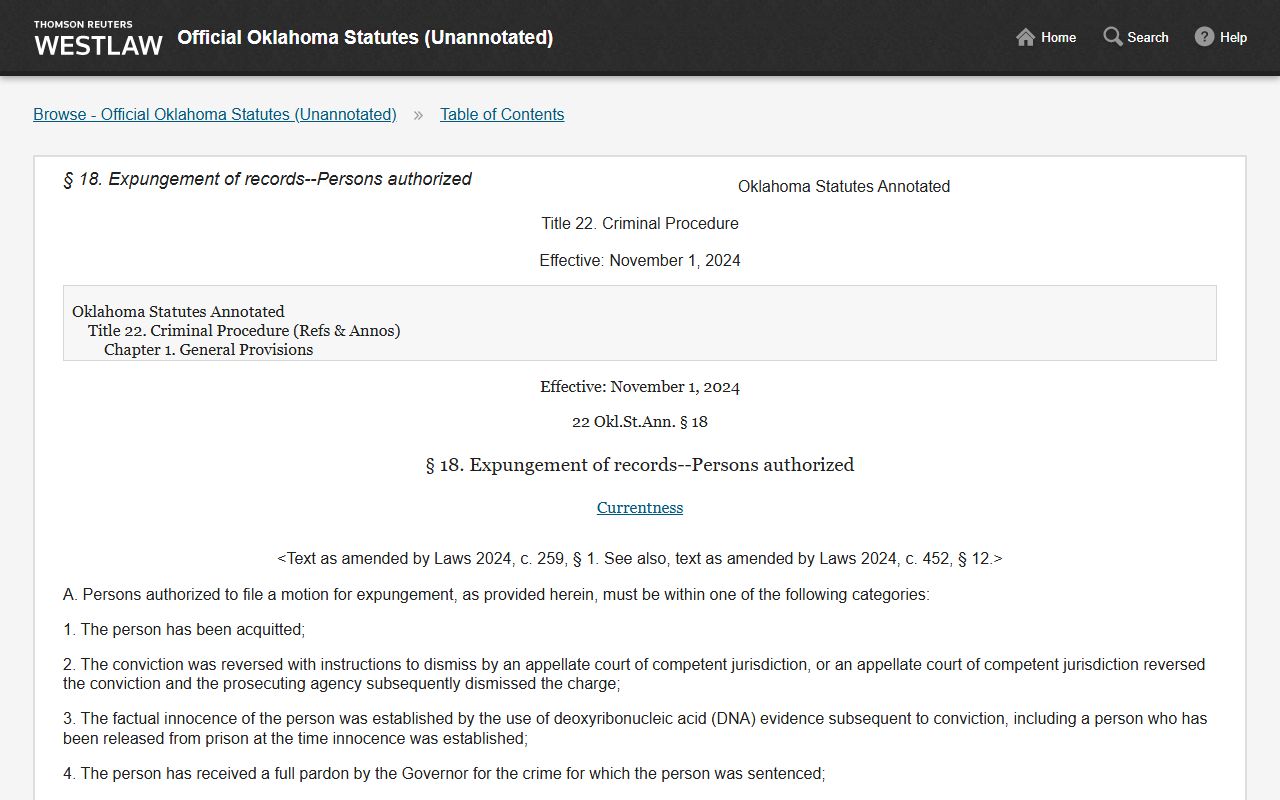
The statute groups eligible people by the result of their case, such as a dismissal, an acquittal, or a completed deferred sentence after a waiting period. It does not promise that every arrest or conviction qualifies.
| Sealed | Expunged | |
|---|---|---|
| Visibility | Hidden from public | Destroyed or treated as never existed |
| Law Enforcement | Limited access | Very limited |
| Eligibility | By court order under 22 O.S. § 19 | Must fit a category in 22 O.S. § 18 |
Once a court signs an expungement order, the sealing steps follow a set path. The procedure for sealing and later unsealing a record appears in 22 O.S. § 19, shown here.
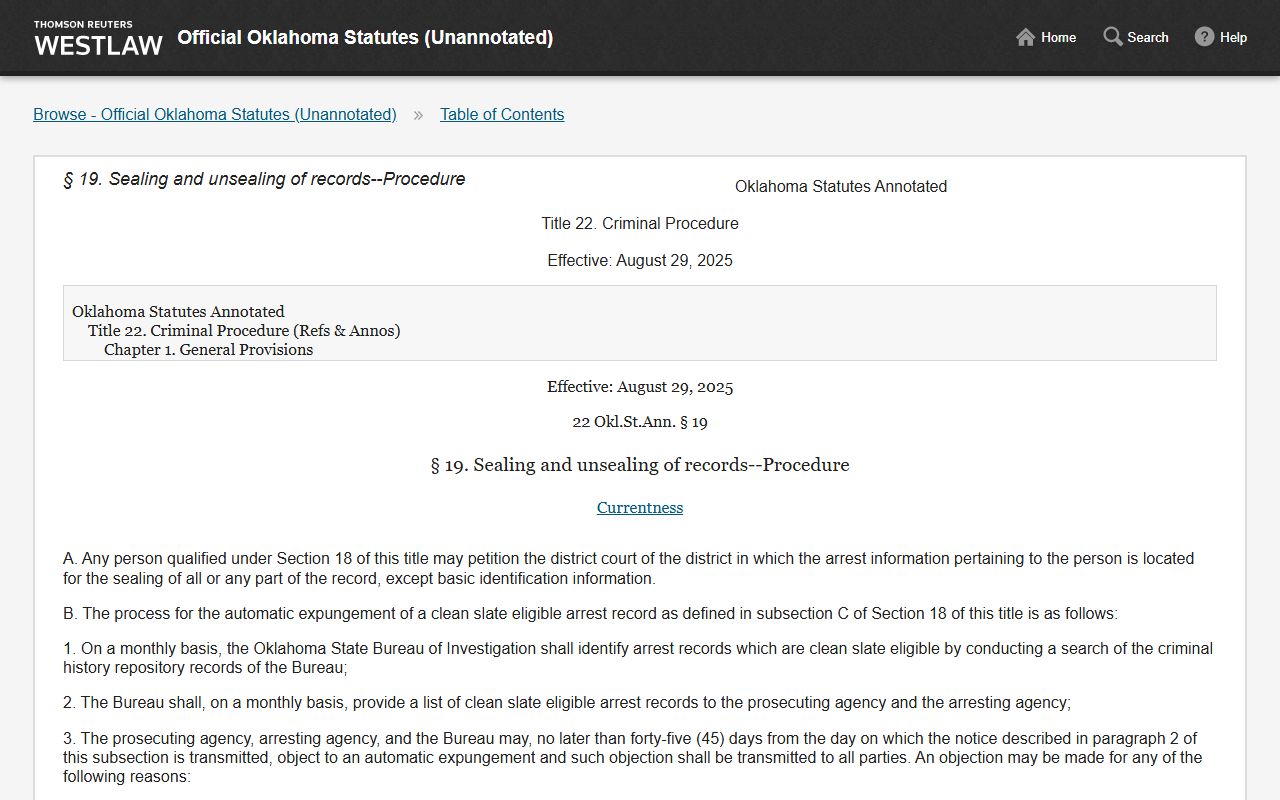
The path runs through the court, not through any website. A person should find the case number on ODCR or OSCN, file the petition with the Grady County Court Clerk, and obtain a signed order. Notice then goes to the prosecuting office, the arresting agency, and the state record keeper. Waiting periods and eligibility turn on the case result, the class of conviction, any pending charges, and the statutory category.
Note: The state record bureau cannot pre-approve eligibility, so confirm your category under the statute before you assume a Grady County case can be sealed or wiped.
Public Access to Grady County Criminal Records
Criminal case files are open to the public in Oklahoma unless a specific law makes a record confidential. The Oklahoma Open Records Act sets the general framework, and court rules treat the online systems as a public convenience. The state defines what an expungement is and where the authority for it comes from, and that source page is shown below.
The official definition and authority for criminal record expungement is captured in the state statute view here, from the Oklahoma expungement authority page.
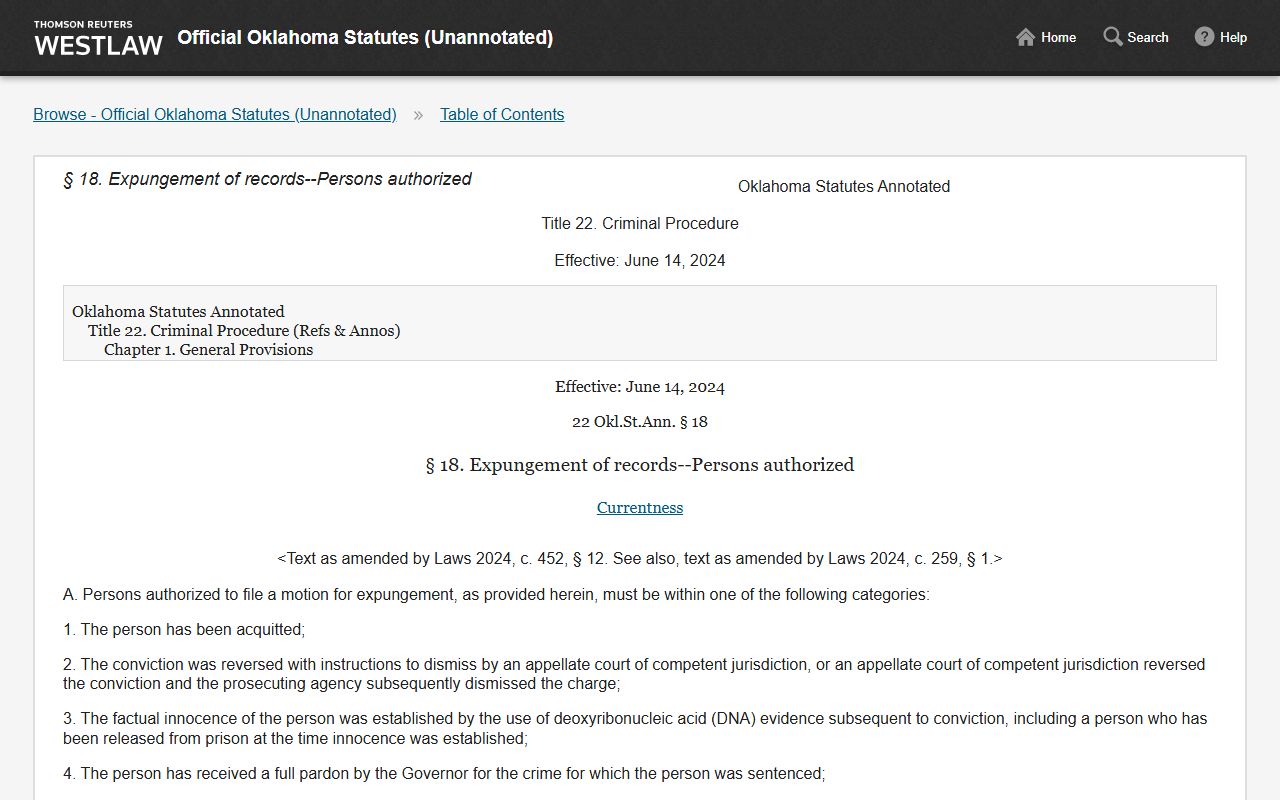
That authority is why a sealed or expunged Grady County case may not surface in a routine search, even though the case once existed. For day-to-day access, the law keeps most files open, and the rules below show how it works.
Key Statutes:
51 O.S. § 24A.5 - Public bodies must let people inspect and copy open records during business hours and must post their fee schedule.
51 O.S. § 24A.8 - Sets the rules for law-enforcement records, making arrest and incident facts available while shielding protected material.
OCCA Rule 2.6 - OSCN case search is a public convenience, and the court relies on the official case-management record if the two differ.
Background Check Considerations
Reading a case file online is not the same as a formal background check. A casual lookup on ODCR or OSCN gives you index and docket facts, but it is not a screened, verified report. Employers, landlords, and lenders who run checks must follow federal rules and use a regulated agency. The official, certified version of any Grady County criminal record always comes from the Court Clerk.
Important: This site is not a consumer reporting agency under the Fair Credit Reporting Act, and its data may not be used for credit, hiring, housing, or insurance screening.
Restricted Criminal Court Records in Grady County
Some criminal files sit outside public reach by law. Juvenile cases are the clearest example, and Oklahoma keeps them confidential. Sealed and expunged files drop out of public search once a court signs the order. Active investigations, search warrants before they are returned, and mental-health proceedings may also be held back. Adoption files are restricted as well, so they are not searchable like a routine case.
Juvenile records are confidential under 10A O.S. § 2-6-102, shown in the statute capture below.
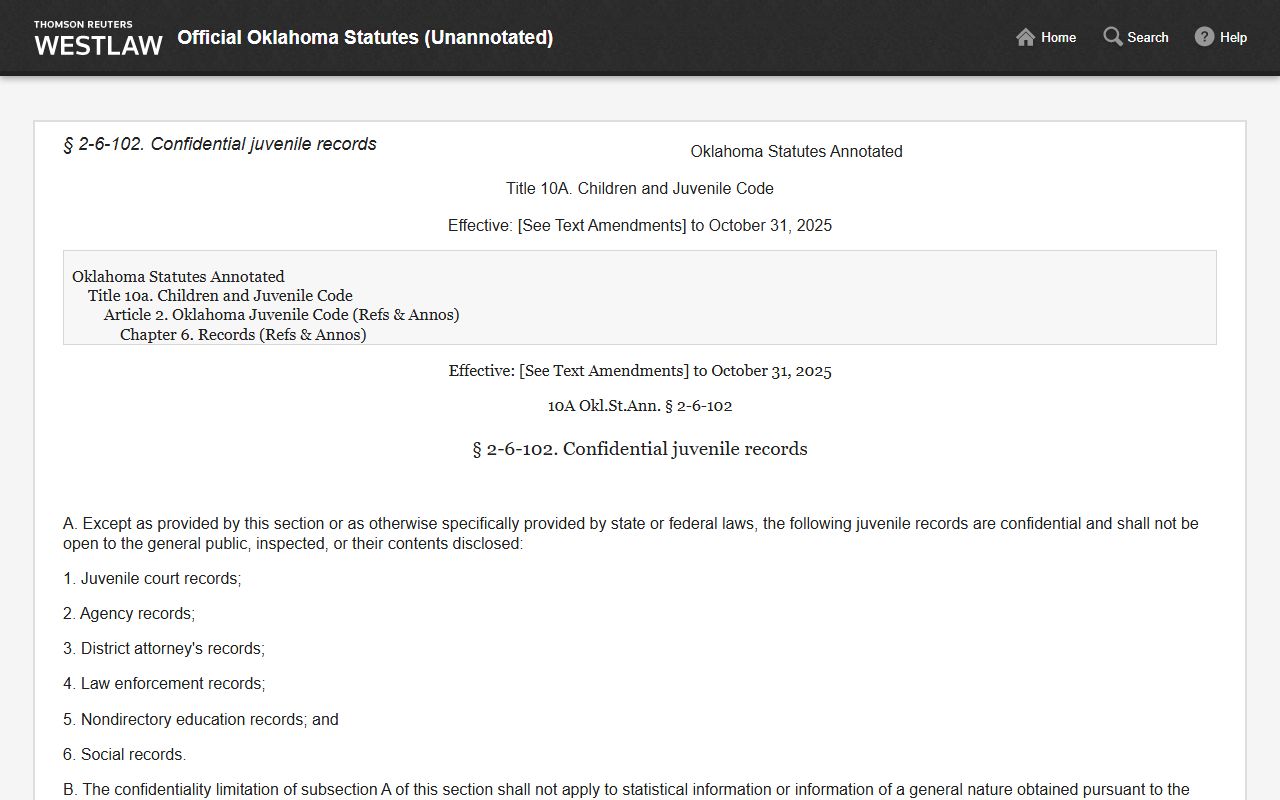
That law means a juvenile court file in Grady County is not open to the general public, and only authorized parties may view it without a court order. When a file is restricted, the right move is to contact the Court Clerk and ask what access path, if any, applies to your situation.
Note: When a record does not appear in a public search, it may be sealed, juvenile, or confidential rather than missing, so verify status with the Grady County Court Clerk.